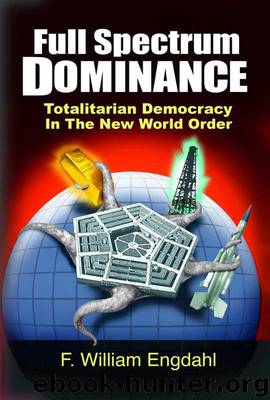
Full Spectrum Dominance: Totalitarian Democracy in the New World Order by F. William Engdahl
Author:F. William Engdahl [Engdahl, F. William]
Language: eng
Format: epub
Publisher: mine.Books
Published: 2011-10-20T06:00:00+00:00
That statement, written well before the US-led bombing of former Yugoslavia and the US military occupations in Afghanistan and Iraq, revealed that US policy had never been about getting rid of tyranny. It was about global hegemony, not democracy.
Not surprisingly, China was not convinced that allowing Washington such overwhelming power was in China’s national interest, any more than Russia thought that it would have enhanced peace to let NATO gobble up Ukraine and Georgia, or for the US to put its missiles on Russia’s doorstep allegedly ‘to defend against threat of Iranian nuclear attack on the United States.’
The US-led destabilization in Tibet was part of a strategic shift of great significance. It came at a time when the US economy and the US dollar, still the world’s reserve currency, were in the worst crisis since the 1930s. It was significant that the US Administration sent Wall Street banker and former Goldman Sachs chairman, Henry Paulson to Beijing in the midst of its efforts to embarrass Beijing about Tibet. Washington was literally playing with fire. China long ago had surpassed Japan as the world’s largest holder of foreign currency reserves. By July 2008, China’s US dollar reserves were estimated to be well over $1.8 trillions, most of it invested in US Treasury debt instruments or bonds of Fannie Mae or Freddie Mac. Paulson knew well that Beijing could decide to bring the dollar to its knees by selling only a small portion of its US debt on the market.
By the end of 2008 the global superpower, the United States of America, was looking more and more like the British Empire of the late 1930s — a global imperium in terminal decline. The US empire, however, despite spiraling into its gravest financial crisis since the Great Depression of the 1930s, still seemed determined to impose its will on a world increasingly moving away from such absolutist control.
The world — or at least its major players outside Washington, from Russia to China to Venezuela to Bolivia and beyond — was beginning to think of better alternatives. To the Pentagon, such stirrings made the work of Full Spectrum Dominance more urgent than ever. The declining power of the American Century depended increasingly on direct military control, a control the Pentagon tried to establish through a worldwide network of its military bases.
Download
This site does not store any files on its server. We only index and link to content provided by other sites. Please contact the content providers to delete copyright contents if any and email us, we'll remove relevant links or contents immediately.
| Anthropology | Archaeology |
| Philosophy | Politics & Government |
| Social Sciences | Sociology |
| Women's Studies |
The Secret History by Donna Tartt(19086)
The Social Justice Warrior Handbook by Lisa De Pasquale(12190)
Thirteen Reasons Why by Jay Asher(8909)
This Is How You Lose Her by Junot Diaz(6886)
Weapons of Math Destruction by Cathy O'Neil(6279)
Zero to One by Peter Thiel(5801)
Beartown by Fredrik Backman(5754)
The Myth of the Strong Leader by Archie Brown(5507)
The Fire Next Time by James Baldwin(5444)
How Democracies Die by Steven Levitsky & Daniel Ziblatt(5218)
Promise Me, Dad by Joe Biden(5153)
Stone's Rules by Roger Stone(5087)
A Higher Loyalty: Truth, Lies, and Leadership by James Comey(4962)
100 Deadly Skills by Clint Emerson(4925)
Rise and Kill First by Ronen Bergman(4788)
Secrecy World by Jake Bernstein(4753)
The David Icke Guide to the Global Conspiracy (and how to end it) by David Icke(4717)
The Farm by Tom Rob Smith(4507)
The Doomsday Machine by Daniel Ellsberg(4490)
